
Construction RA Bill, EVM, and Budget Tracking Software for Indian Contractors
Cost variance visible at week 2, not month-end
Budget by cost code, earned value metrics, RA bill tracking, and variance alerts. All connected to the live project schedule, not a separate spreadsheet.
Cost overruns appear at the quarterly review, not week 3
By the time a cost overrun appears in the monthly commercial report, it has been building for three weeks. The budget spreadsheet is maintained by the commercial manager, updated from emails and phone calls, and distributed as a PDF on the last day of the month.
The data is always a month old. The corrective action always comes too late.
Month-end commercial reports are already too late
By the time the report is compiled, the overrun is three weeks old. The subcontractor has already invoiced, the material is on site, and the budget is spent.
EVM calculated in a separate spreadsheet
CPI and SPI are calculated in Excel, manually updated from field progress data. The formulas are fragile. The results are always a few days behind.
RA bills tracked in email threads
The status of a payment application (submitted, certified, disputed, paid) lives in a chain of emails between the commercial manager and the principal.
Cost codes inconsistent across projects
Every PM maintains their own cost code structure. Cross-project comparison requires hours of manual reconciliation before a director can see a meaningful number.
Approved variations not reflected in the working budget
A signed variation order sits in a folder. The working budget doesn't change until someone manually adds it to the spreadsheet, sometimes weeks later.
No early warning before the overrun is unrecoverable
A project running 8% over budget at week 6 shows up at the month-end review. At week 3, the overrun was still recoverable. That window closes silently.
Budget, EVM, and RA bills from the same live project
CivilBolt builds the budget from the contract cost codes, calculates earned value from daily field progress, tracks RA bills by submission and certification date, and alerts on variance before it becomes unrecoverable.
Your commercial team works from live data. Directors see portfolio health without compiling a report.
Budget populated from contract cost codes
Contract awarded amounts broken into cost codes at upload. Actual spend tracked against each code as work progresses and invoices are entered.
Earned value from field progress, not a formula
CPI and SPI calculated from daily log quantities and task completion, updated daily. Not from a spreadsheet formula that someone forgot to update.
Variance alerts at the threshold you set
Set a cost variance threshold and get an alert when a cost code crosses it. Week 2 visibility, not month-end reconciliation.
RA bill tracker with certification deadlines
Log each payment application with submission date, certified amount, disputed items, and payment status. Certification deadlines tracked and alerted.
Approved variations added to the working budget
Variation orders entered into the project update the budget immediately. EAC recalculates with every approved change.
Director portfolio view across all projects
All projects visible with CPI, EAC, and budget health. Updated in real time, not at month-end. No report to compile.
From contract value to live EVM in three steps
No separate spreadsheet. No month-end data entry.
Contract value and cost codes populated at upload
Awarded contract amount and cost codes extracted from the contract document. Budget structure ready before the first invoice arrives.
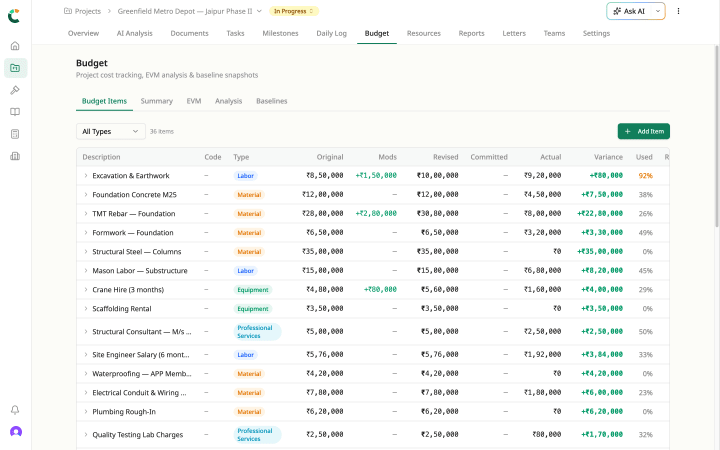
Daily field progress drives earned value
Daily log quantities and task completion flow into CPI and SPI calculations automatically. Earned value is a product of what's happening on site, not a spreadsheet formula.
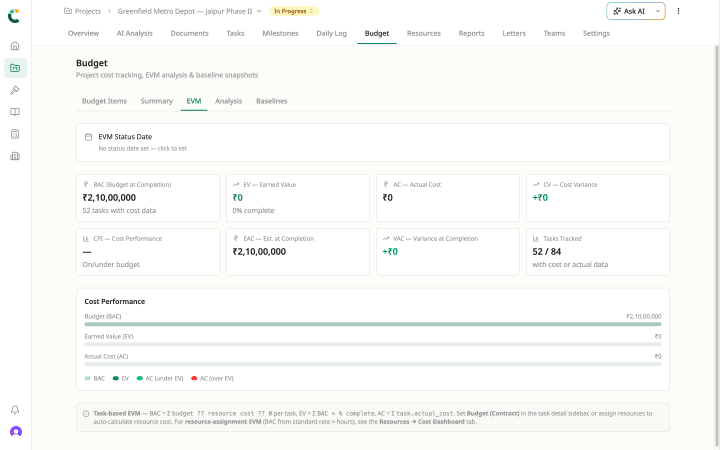
RA bills tracked from submission to payment
Log each payment application with submission date, certified amount, and payment status. Certification deadlines calculated from the contract. Overdue certifications flagged automatically.
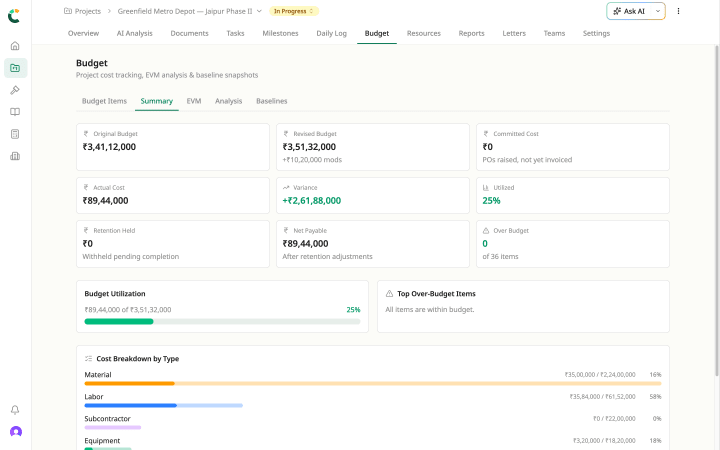
Inside the project management workspace
Commercial ships alongside the rest of the Project Management workspace. They share the same uploaded document, the same project record, the same Civil Brain reading across all of them.
See cost variance at week 2, not month-end
Custom quote · 14-day pilot on a live project · Implementation in 2–4 weeks.
Earned value
Cost variance, the moment it shows up. Drag the value you’ve earned against the cost you’ve spent. CPI, SPI, and the variance recompute live.
CPI · cost
0.83
earned ÷ spent
SPI · schedule
0.88
earned ÷ planned
Cost variance
−₹6 Cr
earned − spent
Drag the two points to set what you’ve earned and spent this period.